XI weighted above everything
If the prediction does not show the XI it relied on, the rest of the read is speculation. The desk treats the XI as the floor of the prediction, not the opening paragraph.
A bounded evergreen explainer on what a fantasy cricket prediction depends on during the sixty minutes between the team sheet and the toss: the playing XI in as evidence, the pitch read as anchor, the weather cue as gate, and the captain pick as the last sentence of the chain, not the first.
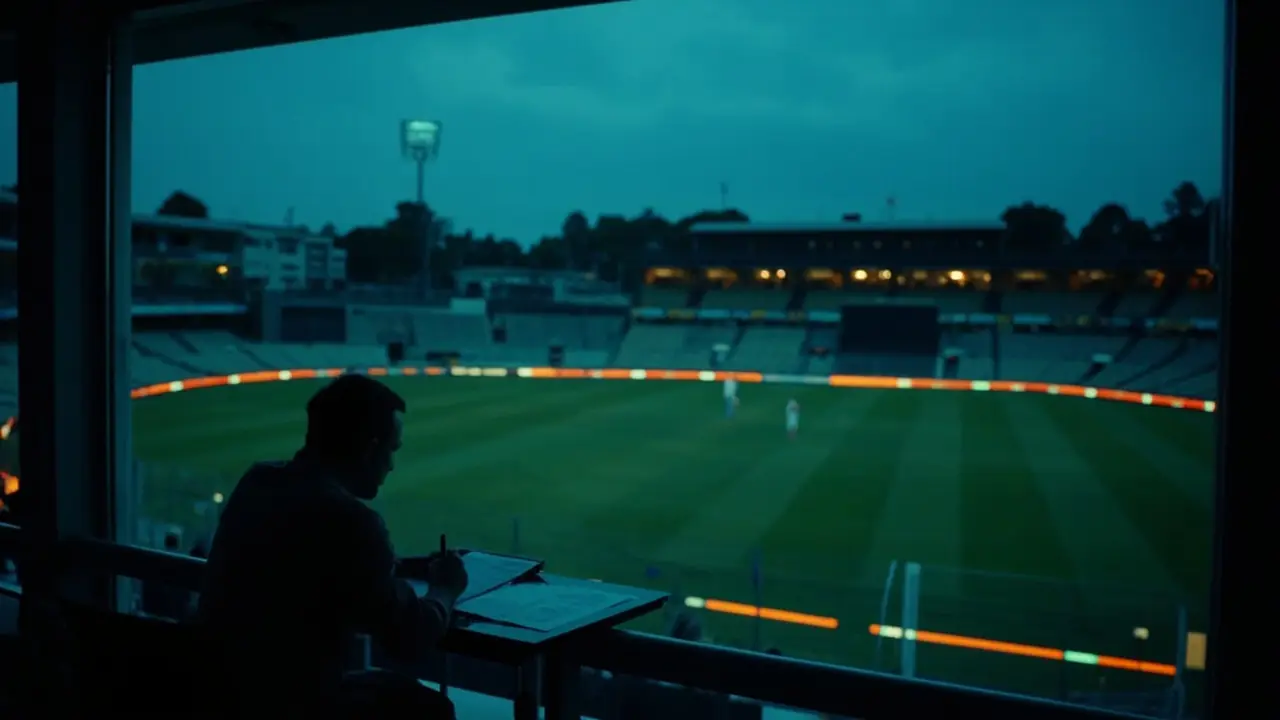
Five minutes before the toss at a domestic T20 ground, an analyst at the back of the press box sets a printed team sheet on her notebook. The screen at the bowler's end has just cycled to the venue logo. The dew forecast on her phone reads 64%. The captain pick she is about to write is the smallest part of the work in front of her, and the only part most fantasy cricket previews treat as the work. The order is the mistake. A captain pick written before the team sheet is read is a guess. A captain pick written after the pitch has been read but before the dew probability has been checked is a half-formed sentence. A captain pick written after the playing XI, the surface, and the dew have all been verified, with a contingent line for the toss outcome, is a prediction that earns its keep.
This explainer walks the chain in the order the desk actually runs it. The player names changing a fantasy XI between a good and a bad read are usually not the deciding factor. The order in which the analyst checks the inputs is. The captain pick is the output of the chain, and the chain is what this desk is committed to.
The first sixty minutes of the prediction window belong to the playing XI. The team sheet, once printed, is the only verified input in the read. Every later signal, the pitch read, the dew probability, the captain candidate, depends on who is actually on the field. The desk treats the published XI as evidence and treats the probable XI circulating across social channels as rumour, regardless of how often the rumour turns out to be correct. The two are not the same input, and the fantasy cricket prediction that blurs them is the one that gets the captain pick wrong by one name.
The first pass is a single scan for names that change the role weighting. A spinner who turns the ball away from the left-handed top three. A second seam option who bowls at the death. A travelling wicketkeeper who replaces the named batter in the playing XI. The desk checks each of those against the team sheet rather than against the social card, and the captain pick is rebuilt around the names that actually crossed the boundary rope.
Three quieter signals move a captain pick more than a reputation does. The position of an all-rounder in the batting order: a number four usually means batting depth and a likely bowl in the middle overs; a number seven usually means a bowler-first role who bats to keep the innings together. The composition of the seam attack: a right-arm heavy combination attacks a left-handed top three differently from a mixed combination, which in turn changes which batter is worth the captain multiplier. The presence of a second wicketkeeper: a like-for-like swap that the desk treats as a separate role, not a duplicate.
The pitch read carries the second-most weight, and the rule is narrow: a pitch read that does not name the venue is not a pitch read. The same team sheet produces a different captain pick on a flat Arun Jaitley surface than on a two-paced Wankhede track, and the desk treats the venue as part of the read rather than as a footnote. The desk's starting proportion is two pace options to one spinner on a carry surface and the reverse on a turner. The proportion is not deterministic; the bowler matchup, the dew forecast and the overhead lights all push it around. The narrow rule is what the desk will not publish without: a captain pick has to name the surface type and the venue's recent first-innings average. Without those two data points the bowler read is invented.
The chase is favoured in roughly half of T20 venues in a typical season, and the chase advantage is not evenly distributed. Some venues are flat enough that 180 is routine; at those venues the second-innings batting order is the captaincy bet. Other venues are slow enough that 140 is competitive; at those venues, wickets in the powerplay decide the match and the bowling captain pick is the bet. Reading "the venue favours chase" without the first-innings average is a soundbite, not a signal, and a captain pick built on a soundbite is a captain pick the desk quietly downgrades.
The weather cue is the gate that decides whether the rest of the chain runs at all. Three weather variables matter for a fantasy cricket prediction, and they carry different weights.
That threshold is the gate. Above 60% the ball stops gripping in overs 12 to 20, spinners lose their edge, and the captain pick migrates from a bowling all-rounder to a powerplay batter who will face the easier half of the chase. Below 50% the dew is too speculative to override form. The 50-to-60% band is where the desk makes a separate call from the published forecast and trusts the closer source. The desk uses two independent forecasts, and only treats the higher number as a factor when both agree. A fantasy cricket prediction that treats the dew as a single bullet is a prediction that has not yet read the gate.
A wind blowing straight down the ground shortens the effective boundaries for straight-bat shots, and the boundary-hitting captaincy candidates earn 6 to 12 more fantasy points when the wind helps them. A wind blowing across the ground changes which side of the field is short and which batter is hitting into it. The desk reads this as a small but real swing on a 170-run track, where two viable captain calls can be separated by a single boundary side.
Lights matter when the white ball swings earlier. On a green surface under lights in the evening session, the new ball can move through the first three overs when otherwise it would not. The effect is small, on the order of a three to five fantasy-point ceiling swing on a seam-bowling captaincy candidate. That swing does not, on its own, justify moving the captain off an obvious batting choice. The desk includes the lights only as a modifier on the seam read, never as a stand-alone variable.

The captain pick is the last sentence of the chain, and the desk treats it that way. A published captain pick written before the XI is read is a guess. A captain pick written after the surface and dew have been read but before the toss lands is a conditional guess. A captain pick written after the XI, the pitch and the dew have all been verified, with a contingent line for the toss outcome, is a prediction worth carrying forward into a real XI.
The obvious captain is the most-picked player in the pool, which means the multiplier is competed for and the ceiling is crowded. The desk's working rule is to look at the second and third most obvious captain calls and ask whether they share the surface and the dew read. When they do, the multiplier gap between them and the obvious pick is small enough to make the obvious pick the desk's recommendation only when the obvious pick also passes the surface read. The captain call that holds is the captain call that does not depend on a single signal to be true.
Tier one: a captain pick that holds regardless of the toss outcome, built around a powerplay batter on a flat track or a death bowler on a green-seam track. A high-floor rather than high-ceiling call, and the tier the desk leads with when the dew is uncertain. Tier two: a captain pick that depends on the toss, built around a spinner on a turning track who bowls in the second innings (useful only if bowling first), or a powerplay batter who faces a dew-faded second innings (useful only if chasing). Both tiers go on the read; the reader picks whichever matches the toss.
If the prediction does not show the XI it relied on, the rest of the read is speculation. The desk treats the XI as the floor of the prediction, not the opening paragraph.
A specific surface type and a recent first-innings average at the named ground. Generic "batting-friendly" without either is not a pitch read.
A named number, not a forecast bullet. Below 50% the dew does not move the captain pick. Above 60% it does, and the 50-to-60% band is the desk's separate call.
A primary captain call and a contingent captain call for the toss outcome. A single-line captain pick is a guess, not a prediction.
The prediction coverage at the broader desk area carries the live match previews, the toss updates and the post-toss audit calls that this explainer cannot include. The inferential chain above is the order the desk applies before any of those calls go live. A reader who wants to compare a desk captain call against their own XI should run the desk call through the same four stages and ask which input the desk trusted more than the reader would have. That is where the disagreement matters, and it is where the editorial work sits.
Three classes of pre-toss information cannot be folded into the chain above. Late injury news after the team sheet is printed, including a fast bowler who warmed up at 80% capacity and is now visibly restricted. A net session where a player is batting or bowling in a style they have not shown publicly, rare but observable in a small share of pre-toss windows across a season. A confirmed playing XI that does not match the social media card the broadcaster displays, a deck-class reporting error more common than the desk would like.
This explainer is bounded by the source-ladder used elsewhere on this desk: it uses generic, hypothetical examples for the worked read and avoids any claim about a current event, partnership, offer, score, statistic or verification timestamp. A reader who needs a venue-specific captaincy note for a particular fixture should follow the live coverage at the predictions desk for the post-toss call.
The four inputs stay the same across a season. What changes is the order in which they should be weighted. On a green-seam track under lights the captain pick leans into the seam bowler. On a slow turner with late dew the captain pick leans into a powerplay batter facing the chase. On a flat batting track with no dew, the captain pick reverts to form. The chain is durable; the specific weight in any given hour is what the desk recalculates. A reader who wants to audit a published prediction against their own XI can apply the same four stages in order, write down where they would have weighted differently, and compare the captain call that survives.
The single sharpest test of any pre-toss prediction is whether the captain call changes when the toss lands. A prediction that names a captain and a contingency, and the captain does not change at the toss, is a prediction that did not earn its keep. A prediction that names a captain and a contingency, and the captain does change, is the kind of read this desk is built around. The next verified event worth watching is the next toss published with a two-tier captain call.