TG20 League 2026 Standings of 8 July: Hyderabad E-Champions Closed the League Stage Unbeaten
On 8 July 2026, a contemporaneous points table for the inaugural Sreenidhi University TG20 League captured the eight-team order after every franchise had completed its seven league fixtures. The snapshot still matters for anyone reading domestic T20 structure in Telangana: one side finished the round-robin with a perfect record, three others sat on identical points, and the playoff bracket was already locked into an IPL-style four-match finish at a single Hyderabad venue.
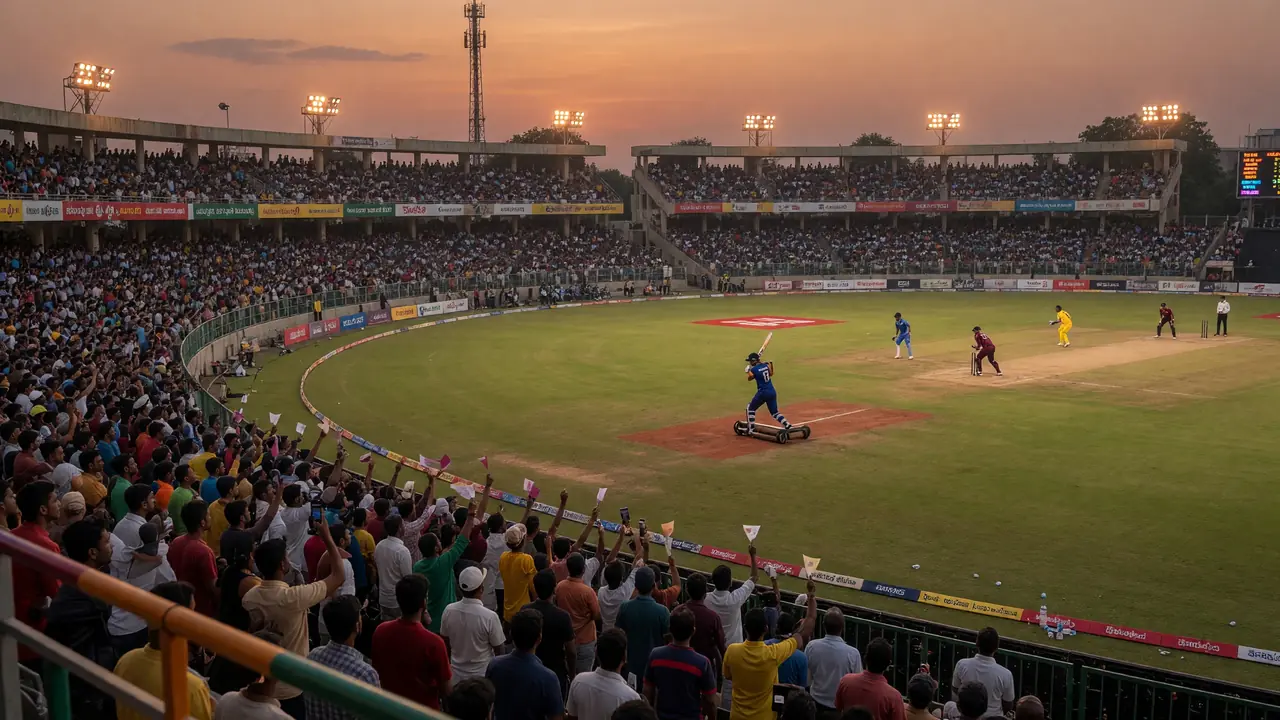
A full league stage, frozen the day after the last round-robin games
The table that circulated on 8 July 2026 was not a mid-season estimate. League play had been scheduled from 21 June through 7 July, with each of the eight franchises facing every other side once. By the morning after that final league day, every team sat on seven completed fixtures, and the four playoff berths could be read directly from points and net run rate rather than from remaining fixtures.
The competition itself was the first franchise-based T20 league staged in Telangana under the Hyderabad Cricket Association, with BCCI approval and Sreenidhi University as title sponsor. All 32 matches — 28 league games and four playoffs — were allotted to Rajiv Gandhi International Cricket Stadium in Uppal. That single-ground design removed venue-to-venue pitch variance from the table and put every franchise on the same surface for the full three-week window.
Broadcast notes attached to the same contemporary report listed Star Sports Telugu on linear television and JioHotstar for streaming, with the official site at tg20.org. Squads were headlined by India internationals including Tilak Varma and Mohammed Siraj. Those details frame the standings as more than a local club ladder: the table sat inside a fully branded, nationally carried domestic product.
How the eight franchises finished the round-robin
Positions, wins, losses, no-results, points and net run rate as published with the 8 July standings snapshot.
| Pos | Team | P | W | L | T | NR | Pts | NRR |
|---|---|---|---|---|---|---|---|---|
| 1 | Hyderabad E-Champions | 7 | 7 | 0 | 0 | 0 | 14 | +1.879 |
| 2 | Anvita Khammam Aces | 7 | 5 | 2 | 0 | 0 | 10 | +0.270 |
| 3 | Karimnagar Diamonds | 7 | 4 | 3 | 0 | 0 | 8 | +1.424 |
| 4 | Anurag Nalgonda Knights | 7 | 4 | 3 | 0 | 0 | 8 | +1.240 |
| 5 | Pranava Ranga Reddy Risers | 7 | 4 | 3 | 0 | 0 | 8 | +0.809 |
| 6 | Palamuru Strikers | 7 | 1 | 5 | 0 | 1 | 3 | -1.295 |
| 7 | Warangal Warriors | 7 | 1 | 5 | 0 | 1 | 3 | -2.504 |
| 8 | Medak Falcons | 7 | 1 | 6 | 0 | 0 | 2 | -1.988 |
Two bands jump out immediately. At the top, Hyderabad E-Champions converted every league match into two points and finished four points clear of second place. In the middle, three sides — Karimnagar Diamonds, Anurag Nalgonda Knights and Pranava Ranga Reddy Risers — finished on eight points with identical 4–3 win-loss lines, so net run rate alone sorted third, fourth and fifth. At the bottom, Palamuru Strikers and Warangal Warriors each banked a single win plus one no-result for three points, while Medak Falcons closed on two points from one win and six losses.
An unbeaten league stage and a clear second seed
Hyderabad E-Champions' 7–0 record produced 14 points and a net run rate of +1.879. In a seven-match league that is the cleanest possible league-stage ledger: no shared points from abandoned games, no late slip that would have forced a final-day calculation. The NRR figure also shows the wins were not all last-ball escapes. A rate near +1.9 across seven completed games usually means a mixture of early chases and comfortable defences rather than a string of one-wicket finishes.
Anvita Khammam Aces locked second place on 10 points from five wins and two losses. Their NRR of +0.270 was positive but modest next to the three sides immediately below them on the table. That split is useful for anyone revisiting the season: Khammam did not need a heavy run-rate cushion because the win column already separated them from the eight-point cluster. The 1st-versus-2nd Qualifier berth therefore went to a side that had already earned a double chance through results rather than through margin of victory alone.
For fantasy readers looking back at the league stage, the top two tell different selection stories. An unbeaten side with a high NRR tends to distribute points across several roles — openers who finish chases quickly, death bowlers who protect totals, and fielders who convert half-chances. A second-placed side with a flatter NRR often still has one or two high-ceiling individuals, but the team result is more dependent on those players converting on a given night. The 8 July table does not name those individuals match by match; it does show that Khammam's path to the Qualifier was built on winning more often than not, not on blowing opponents away every evening.
Three teams, one NRR ladder, two playoff tickets
Karimnagar Diamonds, Anurag Nalgonda Knights and Pranava Ranga Reddy Risers each finished with four wins, three losses and eight points. Under the published tie-break order — points first, then NRR, then head-to-head — the NRR column decided the cut. Karimnagar's +1.424 sat clearly ahead of Nalgonda's +1.240, which in turn sat ahead of Ranga Reddy's +0.809. The first two advanced; the third missed the knockout bracket despite matching the winners' win total.
That is the structural lesson the table still teaches. In a short seven-match league, four wins is often enough to stay alive deep into the final week, but it is not automatically enough to finish inside the top four once three sides land on the same points. Net run rate becomes a season-long account rather than a last-day gimmick. Sides that win by large margins early create a buffer that later narrow defeats cannot fully erase; sides that scrape home repeatedly can still miss out if another four-win team has been more clinical.
The gap between third and fifth was only 0.615 in NRR, yet that gap was decisive. Fantasy and form readers sometimes treat three teams on eight points as interchangeable. The 8 July snapshot shows they were not. Karimnagar carried the strongest margin profile of the trio and therefore earned the Eliminator path as the third seed. Nalgonda's slightly softer NRR still cleared the cut. Ranga Reddy's +0.809, respectable in isolation, was the figure that left them watching the playoffs from outside the bracket.
One win, shared no-results, and a last-place ledger
Palamuru Strikers and Warangal Warriors both finished on three points from one win, five losses and one no-result. The shared no-result is visible in the table as a single NR column entry for each side and explains why two teams with only one win still sat above a side that also won once. Medak Falcons' one win came with six losses and no abandoned game, leaving them on two points and eighth place.
The NRR split inside that lower band is stark. Palamuru's −1.295 was poor but still more than a full run better than Warangal's −2.504. Medak's −1.988 sat between them. Those figures matter less for qualification — none of the three reached the top four — and more for reading how the league stage actually felt on the ground. A side that loses five and still posts only a moderately negative NRR has been competitive in several chases or defences; a side below −2.5 has been beaten by large margins often enough that the table records the damage even after the points column has already written them out of the race.
Single-venue scheduling also means those lower-half NRR numbers were earned on the same Uppal surface that produced Hyderabad's +1.879. There is no away-ground alibi in the ledger. When every franchise plays every match at Rajiv Gandhi International Cricket Stadium, the table becomes a pure record of how each squad used that pitch across seven nights rather than a mix of home comfort and travel variance.
How points and tie-breaks were defined
The points system attached to the same 8 July report followed the familiar domestic T20 pattern. A win returned two points. A tie, after the super-over process, returned one point to each side. A no-result from rain or abandonment also returned one point each. A loss returned nothing. That structure is why Palamuru and Warangal could sit on three points with only one win: the shared no-result contributed the extra point that a pure 1–6 record could not match.
When points were level, net run rate was the first separator. NRR was described in the contemporary explainer as runs scored per over faced minus runs conceded per over bowled, accumulated across the league stage. Only if NRR also matched would head-to-head between the tied sides decide ranking. On the 8 July table, the head-to-head clause never needed to fire for the playoff cut: the three sides on eight points were already ordered cleanly by NRR, and no other multi-team tie sat on the qualification line.
For readers who track fantasy multipliers across domestic leagues, the practical consequence is simple. In a format that awards a full two points only for a win, every completed match carries binary weight, while abandoned games soften the table without rewarding dominance. Captains and death bowlers still decide most of the points on a given night; the table, however, records only the binary outcome plus the cumulative run-rate residue of those outcomes.
Round-robin into a four-match, IPL-style finish
The league stage scheduled 28 matches between 21 June and 7 July 2026. Most days carried two fixtures, with the afternoon game listed at 2:15 PM IST and the evening game at 7:15 PM IST. A rest day on 5 July broke the block before the final stretch of league fixtures. Once those 28 games were complete, the top four advanced into a four-match knockout sequence that closed the tournament on 10 July.
The playoff design copied the familiar Indian franchise template. Match 29 was the Eliminator between third and fourth. Match 30 was the Qualifier between first and second, with the winner going straight to the final and the loser dropping into the second Eliminator. Match 31 paired the Qualifier loser with the first Eliminator winner. Match 32 was the final between the Qualifier winner and the second Eliminator winner. Finishing first or second therefore carried a structural second life that third and fourth never received.
Read against the 8 July table, that structure rewarded Hyderabad and Khammam twice over. They not only locked the top two seeds on points; they also entered the knockout fortnight with the double-chance path that the format reserves for the Qualifier pairing. Karimnagar and Nalgonda, by contrast, had to win every remaining knockout game after the Eliminator simply to reach the final. The points table and the bracket design reinforced each other: the sides that dominated the seven-match league stage kept the softer route through the last four games as well.
One ground, thirty-two matches, one consistent surface story
Every TG20 League 2026 match was staged at Rajiv Gandhi International Cricket Stadium in Uppal, the IPL home of Sunrisers Hyderabad, with a listed capacity near 55,000. Hosting a full franchise league on a single international ground is unusual outside a few domestic experiments, and it changes how a points table should be read after the fact. There is no home-and-away split to decode. There is no mid-season venue rotation that suddenly rewards a different bowling type. The NRR column becomes a record of how each franchise adapted to one pitch as it aged across three weeks of double-headers.
Contemporary notes around the tournament also flagged the usual single-venue caution: as a block of matches piles up on one square, surfaces often slow and offer more grip to spin later in the window. The 8 July standings themselves do not break out early-window versus late-window results, so that pitch-aging claim stays at the level of general venue behaviour rather than a proven driver of this specific table. What the table does prove is that Hyderabad E-Champions mastered whatever conditions Uppal presented across all seven of their league nights, while the bottom three never found a sustained answer on the same ground.
For anyone comparing TG20 with multi-venue franchise leagues, the legacy of that design is clarity. The 8 July ledger is unusually clean: same ground, same points rules, full seven-match sample for every side, and a playoff cut decided without unresolved fixtures. That is why the snapshot remains a useful reference even after the knockout matches that followed it had already been played out by 10 July.
Tournament facts locked to the 8 July record
| Detail | Confirmed value |
|---|---|
| Competition | TG20 League 2026 (Sreenidhi University TG20) |
| Season | Inaugural |
| Organiser | Hyderabad Cricket Association (BCCI-approved) |
| Window | 21 June 2026 – 10 July 2026 |
| League stage | 28 matches, 21 June – 7 July 2026 |
| Standings snapshot date | 8 July 2026 |
| Teams | 8 franchises |
| Total matches | 32 (28 league + 4 playoffs) |
| Venue | Rajiv Gandhi International Cricket Stadium, Uppal, Hyderabad |
| Title sponsor | Sreenidhi University |
| TV / streaming | Star Sports Telugu / JioHotstar |
| Official site | tg20.org |
| League-stage leader | Hyderabad E-Champions — 7 wins, 14 pts, NRR +1.879 |
| Playoff cut line | Top four after seven matches each |
Common questions about the 8 July TG20 table
When was this points table current?
Who topped the TG20 League 2026 league stage?
Which teams reached the playoffs on this table?
How were teams separated when points were level?
Where were the matches played?
What points did a win, tie or no-result return?
How did the playoff bracket work?
Was the league approved and nationally carried?
A clean domestic template, preserved at full sample size
Retrospective tables are easy to dismiss once a final has been played. This one earns a longer look because it captures a complete league stage rather than a mid-season cliffhanger. Every franchise had the same seven-match sample. The venue never changed. The points rules were standard. The playoff cut landed on a three-way NRR decision rather than on a washed-out final round. For editors and fantasy analysts who compare domestic T20 structures, that combination is rare enough to keep on file.
The enduring picture from 8 July 2026 is straightforward. Hyderabad E-Champions turned the league stage into a procession and took the Qualifier route with a perfect record. Anvita Khammam Aces secured the second double-chance seat on wins rather than on runaway margins. Karimnagar Diamonds and Anurag Nalgonda Knights survived the eight-point cluster on NRR, while Pranava Ranga Reddy Risers became the cautionary case of a four-win side that still missed the bracket. Below them, two one-win sides shared a no-result and a three-point ceiling, and Medak Falcons closed the table on two points.
Readers who want the wider calendar context around domestic franchise windows, knockout design and venue concentration can continue through the desk's tournament coverage, where TG20 sits alongside the other 2026 blocks that shape weekly fantasy workload. The 8 July ledger remains the cleanest single-day record of how Telangana's first franchise T20 league sorted itself before the knockout nights began.